Three Scenarios: How Chip Exports Reshape Economic Competition
Advanced AI chips power the cyber operations, model development, and AI infrastructure that will shape economic competition over the coming decades. Decisions about who has access to those chips will have significant economic consequences.
Exporting advanced AI chips to strategic competitors is not a neutral commercial decision. It strengthens our competitors’ AI industries and shifts the economic balance of the coming decades. American chip export policy should be made with these stakes clearly in view.
This site examines three mechanisms through which exporting advanced AI chips affects the U.S. economic position:
- Cyber operations that enable industrial espionage against American firms.
- Distillation attacks that extract intellectual property from frontier American models.
- The buildout of a rival AI stack that competes with American products in global markets.
For each mechanism, we share a scenario: what happens when China’s cyber operations, model development, and AI infrastructure deeply impact the U.S. economy, all on the back of American chips. These scenarios should not be interpreted as predictions, but as real risks that U.S. policymakers must consider when making decisions about what advanced chips should be sold to China and what chips must be controlled.
Compute as a Strategic Cyber Resource
Compute will become a decisive resource for cyber operations against highly strategic targets. As less sophisticated actors gain access to advanced cyber tools, vast compute reserves will allow nation-states to outpace many AI-enabled defenders.
Specifically, greater compute enables a rival nation-state to:
-
Develop and train “cyber weapons-grade” models
Purpose-built for offensive and defensive operations. Today’s frontier models with advanced cyber capabilities, such as Mythos or Opus 4.7, are trained as generalists. To gain an edge, nation-states could use compute to train or fine-tune specialized cyber models focused on vulnerability discovery, exploit generation, and attack automation.
-
Deploy AI systems against hardened targets
Cyber task performance scales directly with inference compute (compute used to run the model and generate tokens). UK AI Safety Institute evaluations found that increasing computational resources from 10 million to 100 million tokens improved autonomous attack performance by up to 59%. Many critical capabilities, such as discovering zero-day vulnerabilities, may be limited only by compute budgets.
A nation-state could use its large-scale compute to attack highly strategic and well-defended targets such as military networks, critical infrastructure, and the energy and financial sectors.
What this could look likeScaled theft of American intellectual property
Leveraging large-scale compute to develop and deploy AI systems for offensive campaigns, PRC actors launch one of the largest and most comprehensive economic cyber espionage campaigns in history, targeting American intellectual property and trade secrets across manufacturing, defense, aerospace, semiconductors, and biotech. State-sponsored Chinese firms then use the stolen information to bring competing products to market faster and cheaper, eroding U.S. competitiveness across strategic sectors for years.
Evaluations from the UK AI Security Institute show that model performance on simulated cyber attack scenarios improves with more compute. Each line is a frontier model attempting a multi-step cyber-attack simulation.
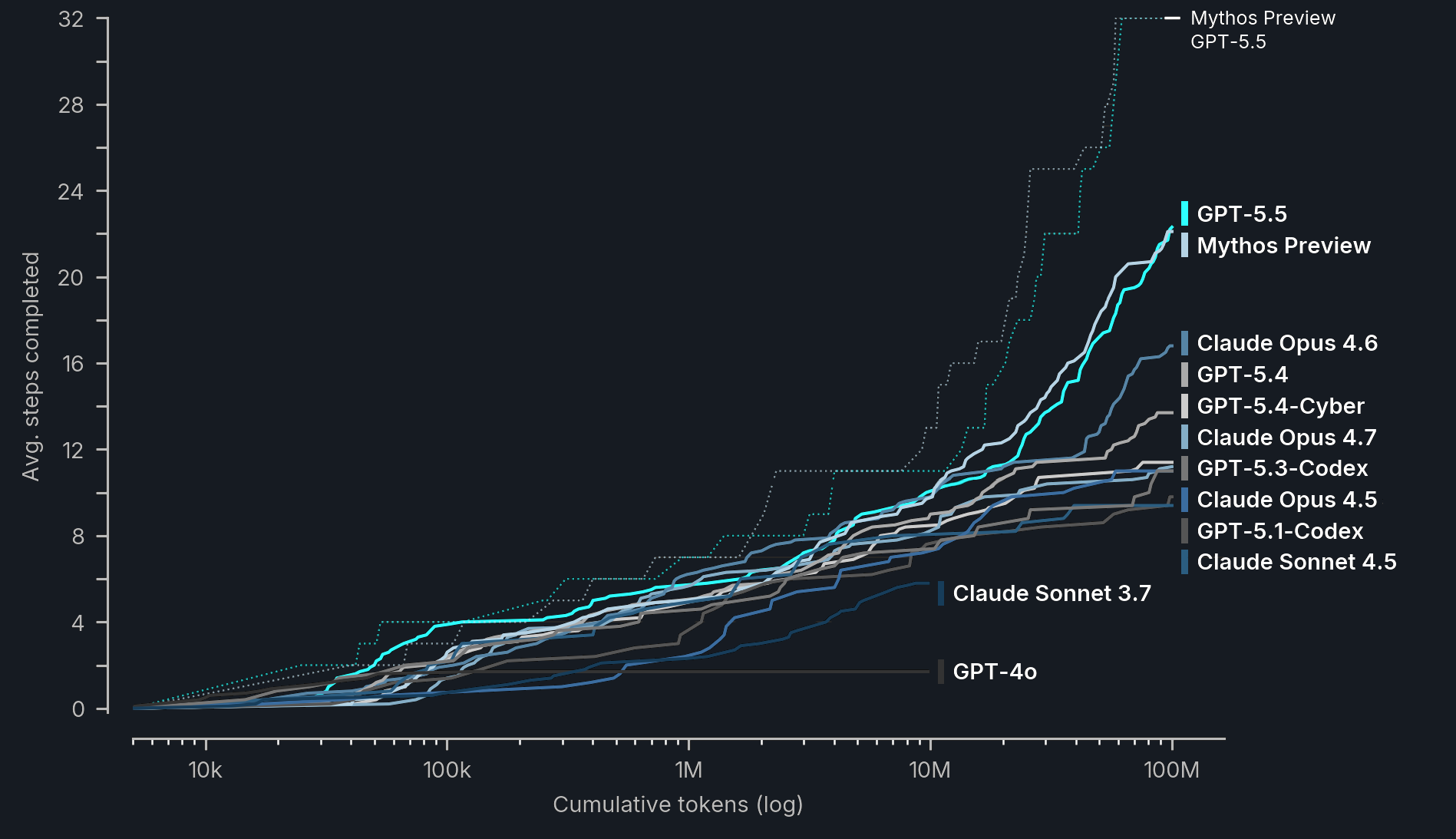
Source: UK AI Security Institute.
Compute as an Engine of Distillation Attacks
Compute enables adversaries to conduct distillation attacks and use that stolen intellectual property to undermine American AI companies’ competitiveness.
Distillation attacks are systematic campaigns to extract capabilities from American AI models. Adversaries can use such attacks to, in essence, steal the advanced capabilities of American models for a fraction of the original development cost.
American frontier AI companies have invested billions of dollars to develop frontier models. With distillation, adversary-linked competitors can release near-frontier models at a significantly lower cost or for free, threatening the commercial viability of American AI. By cutting into American companies’ revenue streams, adversary models could further lower American investment in research and infrastructure.
But distillation is not free: serving, training on, and refining distilled models at scale still requires substantial compute. Additional chip access would allow a rival to:
-
Scale, increase, and improve distillation attacks
Significant compute is required to train adversary models on illicitly acquired model outputs. Greater compute capacity can allow adversaries to run larger, faster, and more sophisticated distillation attacks.
-
Refine distilled models to close the remaining gap
Raw distillation outputs are a starting point, not a finished product. Post-training techniques such as compute-intensive reinforcement learning allow adversaries to further push a model toward a genuine competitor. Distillation attacks effectively subsidize some stages of the training pipeline, freeing up compute that can be redirected toward the other stages it does not substitute well for.
What this could look likeIndustrial-scale theft of American AI capabilities
With additional compute, Chinese AI companies scale up distillation attacks against every major American frontier model release, extracting capabilities within hours of launch. The stolen IP is used in open-weight models released globally and served on Chinese AI companies’ infrastructure at a fraction of the cost of American alternatives, rapidly capturing market share across emerging economies.
American AI companies are unable to compete on price and see international revenues collapse. They are forced to cut the R&D budgets that have built their lead at the frontier. Within a few years, the ecosystem that produced America’s AI advantage has been significantly weakened. Meanwhile, China’s fast-following strategy and compute-intensive model refinement results in Chinese models being the global default, enabling greater Chinese influence on global AI norms, standards, and markets.
Evidence from Epoch AI shows that the majority of an AI company’s compute spend goes towards R&D, which distillation attacks let competitors shortcut.
Source: Epoch AI.
Compute as the Foundation of the Competitor’s AI Stack
Exporting compute helps competitor countries build the most valuable parts of the AI industry, costing American firms global market share in those industries.
The AI tech stack is composed of many layers. Chips sit near the bottom of the stack and power the layers above them: data centers, AI models, and AI applications. These downstream layers are where much of the economic returns to AI accrue. AI is projected to add trillions to U.S. GDP through productivity gains. Nvidia CEO Jensen Huang himself claims, “This [applications] layer on top, ultimately, is where economic benefit will happen.”
Exporting compute lets strategic competitors:
-
Train and serve AI that competes with its American counterparts
Compute is the leading input to model capability and the binding constraint on Chinese model development. Chinese models only lag U.S. models by seven months. DeepSeek founder Liang Wenfeng acknowledged, “the problem we face has never been money, but the embargo on high-end chips.” Compute also powers the use of those models, meaning more customers reached. Many strong applications require strong models. American chips sold to strategic competitors power their data centers, models, and applications.
-
Capture compute capacity that would otherwise serve American firms
There is currently a shortage of advanced AI chips. U.S. AI companies would like to scale up their compute, as would many startups and universities. But limits in key production inputs have led to a compute shortage. Nvidia claims U.S. companies are losing revenue as a result of compute constraints. Chips exported are chips American firms cannot access.
What this could look likeGlobal displacement of the American AI stack
With sufficient compute, Chinese labs reach parity on frontier capabilities and serve them globally at prices American labs cannot match due to lower construction costs and other advantages. Enterprise adoption tips: German manufacturers, Indian banks, and Brazilian retailers run their operations on Chinese models. The productivity dividend AI delivers is intermediated by Chinese firms, with the data flowing through Chinese infrastructure and training the next generation of Chinese models.
American labs lose international API share and the revenue base that funds frontier R&D. The U.S. loses out on much of the economic surplus AI generates over the coming decades.
Analysis from Epoch AI finds that it takes an average of seven months for Chinese models to catch up to the capabilities of their U.S. counterparts.
Source: Epoch AI.
About

This site was produced by Americans for Responsible Innovation.